Lower standards for patentability in the US?
See also: “Supreme Court: Current Test of Obviousness is "Gobbledygook”, Patently-O blog.
Thoughts & Thinking on European patent law, technology, R&D and innovation
posted by
IPEG
at
Wednesday, November 29, 2006
0
comments
Biotech is R&D intensive, so research tools are a crucial element in this industry. It is not surprising that inventors who have found a new tool to do the expensive research are looking for ways to expand the reach of their tool invention. One way of doing so is to claim that the invention (the research tool, that is the composition or method to do experiments) is not only useful in conducting those experiments, but also in establishing what the result of this research will be, even if one does not know the outcome of this research as yet. Regularly this is referred to as “upstream” research to cover also the “downstream” results of that research. If the inventor of such an “upstream” research tool – such as cell lines, monoclonal antibodies, expression systems etc. - seeks patent protection he wants more than just freedom to operate the initial or “upstream” research tool .
The patentee wants to “reach through” the results of the use of this patented tool to also claim inventions not yet made by him. In claiming his invention he formulates “reach-through claims” which go beyond what he has actually discovered and which he described in detail in the patent specification. The claims extend to generally foreseeable products discovered through use of the invented search tool. The “reach-through” products are identified only by reference to the material or assay used to find or identify them, but they are not described specifically. An example of such a “reach through” is when someone discovers a new protein which might be suitable for use as a drug target. He is not satisfied to obtain protection only for the isolated drug target and methods of screening for drugs which act as inhibitors or agonists (as appropriate) for that drug target. He also wants to obtain explicit protection for all drugs which act as inhibitors or agonists for that drug target. Or in case of a drug screening process, the party who discovers such a process may wish to claim all drugs discovered through that process.
Needless to say that this “reaching through” practise evokes a great deal of excitement, and, as a result, litigation. The key issues is that such reach through patent claims on a downstream product are not automatically rendered novel and inventive simply because it has been discovered through a novel and inventive upstream process. One of the more recent and well known patent fights relate to such a patent: Ariad Pharmaceuticals et al v. Eli Lilly and Company.
What happened? Researchers identified a so called NF-kB signaling biological pathway. Rel or NF-kappaB (NF-kB) proteins comprise a family of structurally-related eukaryotic transcription factors that are involved in the control of a large number of normal cellular processes, such as immune and inflammatory responses, developmental processes and cellular growth. These transcription factors are active in a number of diseases such as cancer, arthritis, chronic inflammation, asthma and heart disease.
A jury found in May 2006 that the US patent (nr. 6, 410,516) that covered the research tool (the Nf-kB signaling pathway), owned by Harvard, the Massachusetts Institute of Technology, and the Whitehead Institute and which was licensed to Ariad Pharmaceuticals, was valid and infringed by Lilly's sale of two products, Evista® and Xigris®. The patent, expiring in June 2019, covers disease treatment methods that affect the NF-kB pathway. The question at stake was if Lilly’s drug was acting on the patented pathway (the research tool) while the drug already existed before the pathway was discovered, would this prior existence of the drug invalidate the patent on the pathway by rendering it not "new", or “novel”? The Ariad patent tried to “reach through” the Eli Lilly drug. If that is allowed, a previously “patent free” drug can all of a sudden be “reached” by a new research tool, as in this case the Nf-kB signaling pathway.
It is a hotly debated issue, for obvious reasons: if the patent is held to be novel, than this research tool becomes a money blockbuster in the hands of the patentee, who can then extend, or reach through, his invention to all molecules and compounds made as a result of the patented research tool. The licensing income would be enormous.
Could Europe have a “Ariad” like outcome as in the US?
Would the “reach through” practice be a viable option in Europe? If so, why would any patent troll not obtain the license rights (or even the European equivalent of the US patent) to this research tool?
European counterpart of the Ariad patent, EP 0407411 B1 (priority 01.03.1988)reads in granted claim 1:“A method of altering expression in a cell of a gene whose transcriptional activity is altered by binding of nuclear factor kappa B (NF-κB) to the enhancer of said gene, comprising introducing an agent which controls dissociation of the nuclear factor kappa (NF-κB—IκB) complex present in the cytoplasm of said cell”
In many European countries the patentee of such a patent, in order to be successful in an infringement case against a “Lilly” type company would have to rely on the section in the EU patent laws relating to infringement by product of a process to establish an infringement claim. As to validity, the requirement that an invention claimed in a European patent must be both novel and involve an inventive step applies to reach-through claims in the same way as conventional claims. A claim to a downstream product is not automatically rendered novel and inventive simply because it has been discovered through a novel and inventive upstream process.
Another issue which is particularly relevant in Europe results from the European approach to evaluating inventive step. The presence of an inventive step is determined by considering the objective technical problem (derivable from the patent application) to be solved by the claimed invention. If an inventive screening process may be used to discover new drugs, then in order to have any prospects of obtaining protection for the potential drugs, a patent application should discuss the problems to be solved by the potential drugs, not just the problems solved by the screening process.
In the United Kingdom it is likely that reach through claims are vulnerable to sufficiency attacks. Following the Court of Appeal’s decision in American Home Products Corporation v Novartis Pharmaceuticals UK Ltd, such claims may be treated as mere invitations to carry out a research project. Unless the patentee has identified and characterized specific compounds using the assay, the court may well find that there are too many uncertainties involved in identifying such compounds to allow the scope of the patentees monopoly to cover any compound identified using the patented assay.
The answer to the European outcome of an Ariad equivalent patent attack remains uncertain. This European “terra incognita” could bear interesting potentials for anyone with a big purse and a cool head.
sources:
(1) Andrew Christie, Amanda Lim, Reach-through Patent Claims in Biotechnology: An Analysis of the Examination Practices of the United States, European and Japanese Patent Offices, University of Melbourne Research Paper No. 176, Intellectual Property Quarterly, Vol. 3, 2005
(2) Hindle Lowther, Reach Through Claims, Chartered Patent Agents, registered trade mark agents and European patent attorneys, Edinburgh, Scotland
(3) Rochelle Seide, Michelle le Cointe, Reach-Through Claims: How far may your patent extend? Baker Botts LLP
(4) Johan Brants, De Clercq, Brants & Partners, Gent, Belgium, Reach Through Claims and SPC's (see on the right side of this IPEG blog under "IP Presentations"

posted by
IPEG
at
Saturday, November 25, 2006
0
comments
The conclusions from the Booz Allen Hamilton study - as mentioned in yesterday's post on this blog ("R&D spending doess not necessarlity increase profits") are quite in line with the points I make in public events. However, the Booz Allen study is often being misquoted, and one needs also to understand the context in which the DTI study is being prepared. The BA study does demonstrate that companies need to manage their investment on R&D as part of an overall effective innovation process. So when people quote as its conclusion that there is 'no correlation with performance', this is misleading.
posted by
IPEG
at
Tuesday, November 14, 2006
0
comments
Companies spend billions of dollars on R&D to boost innovation output in the expectation of increasing profitability. From a study publised today by Booz Allen Hamilton, “Smart Spenders: The Global Innovation 1000“, it appears that it is not as easy as that: R&D spending does not necessarily increase profits. Booz Allen Hamilton’s annual study of the world’s 1,000 largest corporate R&D budgets uncovers a small group of high-leverage innovators who outperform their industries. Financial Times, claims it undermines repeated calls by governments in the UK and Europe for more corporate investments to close the transatlantic technology gap with the US. The Booz Allen Hamilton study, to be published in “strategy+business” seem to come to opposite conclusions as the DTI Scoreboard 2006, a study recently published by the UK Department of Trade & Industry (DTI).
However, the Booz Allen and DTI studies use different methodologies to rate R&D spending and its effects. Booz Allen conducts a more detailed analysis of the financial performance of the world’s leading R&D spenders to find the linkages between spending on innovation and corporate performance. This allows Booz Allen to identify the companies that outperform their competitors by getting better results from their innovation investment.
Both studies find increased R&D investment by the companies that spend the most on R&D spending. However, the Booz Allen study reports that revenues rose at an even faster rate.
Indeed, the most meaningful indicator of innovation investment, R&D spending as a percentage of sales, has decreased steadily since 2001, and by that measure, only 40% of the companies actually increased their spending rate in 2005.
Most importantly, the two studies examine the link between R&D and performance at different levels.
In the end, both studies agree that return on innovation investment depends on the effectiveness of a company’s innovation processes and organization, rather than the magnitude of its R&D spend (“Money doesn’t buy results”). A business also needs to make good strategic choices, demonstrate operational excellence and balance its R&D investment with investment in areas such as market development and design for production.
posted by
IPEG
at
Monday, November 13, 2006
0
comments
"What the judges are saying to the politicians is to get on with it. If theThe unity within the judiciary is the more prominent in comparison with the deep divides among politicians, as was reported in our earlier post. It remains to be seen how much “cloud” the judges have over the legislative process. It surely signals a strong support among practitioners and judges that EPLA and the EU patent court is the only way forward or a united patent enforcement system. Now the politicians must move.
European Commission supports it and if the European Parliament supports it, then
we could see a patent court within three years."
posted by
IPEG
at
Tuesday, November 07, 2006
0
comments
“The judicial authorities shall also have the authority to order the
infringer to pay the right holder expenses, which may include appropriate
attorney's fees. In appropriate cases, Members may authorize the judicial
authorities to order recovery of profits and/or payment of pre-established
damages even where the infringer did not knowingly, or with reasonable grounds
to know, engage in infringing activity.”
posted by
IPEG
at
Sunday, November 05, 2006
0
comments
posted by
IPEG
at
Tuesday, October 31, 2006
0
comments
On October 27, the UK Court of Appeal handed down its judgment in two cases concerning the exclusions to patentability for business methods and computer programs under Article 52(2) and 52(3) of the EPC (s1(2) PA 1977), the first between Aerotel Ltd vs. Telco Holdings Ltd. cs. and the other in the matter of Application Neal William Macrossan.
posted by
IPEG
at
Saturday, October 28, 2006
2
comments
October 25 and 26 the second public patent auction, organized by Ocean Tomo, was held in New York. The first one, in San Francisco on April 5 and 6 had, at best, mixed results. 78 lots of patents ranging from material science, automotive industry, bar code scanners/radio frequency identification (RFID), information technology, to name a few, were among the technologies covered.
In the October 2006 issue of Journal of Intellectual Property Law & Practice (published by Oxford University Press) Dr. Hidero Niioka presents a highly critical view on this new phenomenon. Although patents attract attention as high return on investment opportunities, patents are also notoriously unpredictable to put a value on, Niioka observes. Patents were until recently practically only traded by private dealmakers. Such deals are concluded in negotiations, beyond the public eye. Auctions have surely changed that and have made valuation of patents more visible. Dr. Niioka sees an increased interest in commercialization of IP by IP merchant bankers, brokers and attorney firms. In analyzing the results of the first public auction in April 2006 he concludes that the bidding process was a deception, where it only generated US$ 2,75 million for 24 out of the 78 lots sold. The lowest selling price per patent was about US$ 555, the average price for a patent sold, US$ 30,344, hardly enough to cover the costs of the patent.
In an interesting article dr. Niioka, he described the Gold Rush climate that surrounds patents, exemplary by the RIM vs. NTP, Inc case, that ended in a US$ 621.5 million settlement in favor of NTP, a patent holding company. Niioka signals an “information asymmetry” between the seller and a buyer of patents. IP asset transactions give the purchaser, unlike in an M&A transaction, the chance of a more business and investment relevant information than the seller.
In the last paragraph of his article he doubts whether public auctions, like the one Ocean Tomo organized yesterday and today in New York, are a good marketplace for investors looking for valuable patents. Time to get sufficient due diligence is too short, argues the writer, but more importantly whether valuable patents will ever be auctioned. Auctioneering patents is an indication that the seller does not consider these patents any longer as “core business”, not having a reason anymore to keep the patents for themselves. This may indicate that the seller is out of a particular business or that the patents he auctions are “old timers”, not current technology. Niioka observes that it is improbable that large companies will not make an arbitrary choice regarding which patents to pass along to a patent auction. Nobody wants to create their own competitors either, nor do sellers want their patents to be picked up by patent trolls. There are other issues however that dr. Niioka does not mention. To name one: in a public auction one cannot make specific deals, that are possible in private deals, like a provision covering the situation that the seller is being attacked by a third party for patent infringement, where he can still invoke - his formerly owned – patents, now in the hands of the buyer, with his assistance and against a certain remuneration.
Niioka concludes that entrusting a patent portfolio to an IP merchant banker or patent broker or other IP professional is a better and safer way for a patent holder to exploit his IP.
posted by
IPEG
at
Thursday, October 26, 2006
0
comments
posted by
IPEG
at
Wednesday, October 25, 2006
0
comments
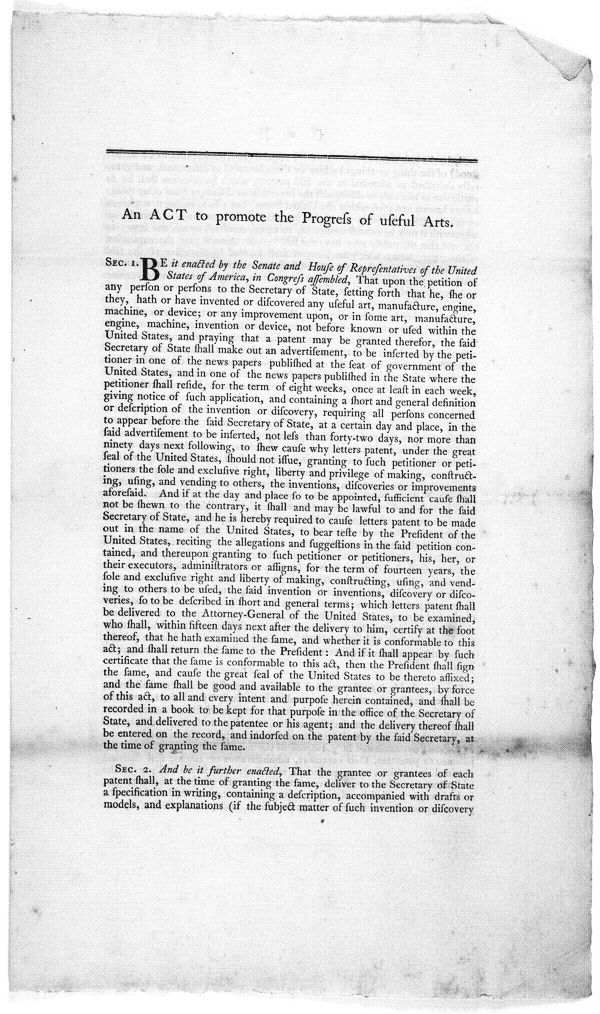
When the United States enacted their first Patent Act in 1790, they made the issuance a matter of the highest importance. There was no patent office. The president himself (George Washington) with assistance of a committee of three (Thomas Jefferson, Henry Knox and the Attorney General Edmund Randolph) met on the last Saturday of every month to review each and every patent application. They established strict rules for obtaining a patent [1].
Although that resulted in too few patents and was soon changed to allow patents without any substantial patent review, this first system of a Patent Review Board consisting of politicians rather than technicians, was never repeated again in any patent system after 1790.
This may soon end. If the European Parliament gets its way, review of patent applications must be a job done under “democratic” supervision. On October 12, the European parliament agreed by a large majority to the European Commission’s plan of going forward with talks on patent reform in Europe, but with a number of amendments to the current plan aimed at ensuring “democratic control” of the process. The vote of the EP was on the Commission’s plan to support the EPLA (see earlier IPEG posts), so the question whether the European Community should “accede to” the European Patent Litigation Agreement (EPLA), which would mean –among other things - the setting up of a European patent court.
Do we want politicians to rule on novelty and inventive step? Hell, no! This very idea signals a worrisome trend in the way politicians look upon intellectual property. Where European innovation falls significantly behind the US and Asia and China surpasses Germany as the 5th world largest supplier of patent applications one would expect European politicians to focus on enhancing innovation rather than beset us with ludicrous ideas about “democratic” review of how patents are being granted by the EPO. European Parliament’s engrossment with so called “undesirable patents” coming out of the EPO (an allegation grossly exaggerated, see memo Severin de Wit to the Dutch Ministry of Economic Affairs of April 15, 2005) prevents a fact-based discussion on how to improve the patent system. It misguidedly focuses on issues that are irrelevant and do not at all help us making the patent system a more effective instrument to further innovation.
The idea of “democratic supervision” is both without merit, incomprehensible and legally nonsensical. Without merit because the question whether a patent has been rightfully granted by the European Patent Office is ultimately for the judiciary to decide, not the lawmakers, nor the executive. Incomprehensible, because there are much more pressing issues to be resolved by European Parliament in making the patent system more apt to the 21st century. Last but not least the whole idea is legally nonsense.
Patents are being granted by the European Patent Office, which is the executive arm of the European Patent Organization, an intergovernmental body set up under the European Patent Convention (“EPC”), whose members are the EPC’s 31 contracting states. Established by the EPC (or “Convention on the Grant of European Patents”), signed in Munich 1973, the EPO is the outcome of the European countries' collective political determination to establish a uniform patent system in Europe. The activities of the EPO are supervised by the Organization’s Administrative Council, composed of delegates from the contracting states. Oversight is being conducted by this Council. Any member of the EU Parliament can lobby its own national members of parliament to take positions and come up with new ideas in the EPO’s Administrative Council.
So what is in the European Parliament members mind when they talk about “democratic” supervision? Do they refer to the concern that EPLA judges would be mostly recruited from the EPO’s Appeal Boards? That is a legitimate concern, but what has that to do with “democratic” review? Or do MEPs mean to say that the current ideas about EPLA and the proposed system of judicial review of EPO patents should not be done by contracting states individually (so by an international agreement between European states), rather than by means of EU legislation like the Community Patent? If that’s the case, again it is a point to make, but what does that have to do with democratizing the grant of patents?
Alternatively, is it that MEPs want to have a say what type of inventions qualify as a “patent” (vide the discussion on software patents)? Lets hope this is not what MEPs really want, because if they do, we better abandon the whole patent system altogether. Why would anyone be attracted by the idea that 732 MEPs vote whether an invention is novel and inventive, so worthy of a European patent?
posted by
IPEG
at
Tuesday, October 24, 2006
0
comments
On 11 October 2006, during the 40th World Congress of the International Association for the Protection of Intellectual Property (AIPPI) in Gothenburg, Sweden, 1,500 national representatives of 44 countries voted on a number of resolutions on pressing IP issues.
A Resolution on EPLA (the European Patent Litigation Agreement), was accepted by the AIPPI representatives. It
"urges the member states of the European Patent Organization
a) to adopt EPLA after convocation of a Diplomatic Conference as early as possible.
b) to invite the European Community represented by the European Commission to co-operate in the preparatory work for the conference with the goal it being ensured that the legal rules of EPLA be in conformity with Community law."
Furthermore the AIPPI World Congress accepted a resolution on other important IP issues, among which the harmonization of national laws on assignment and license of IP rights and the treatment of IP licenses in bankruptcy proceedings.
The Resolution “Q190”, adopted and prepared by a Working Group and discussed by representatives of all countries present at the AIPPI World Congress, calls for harmonization of laws regarding the treatment of assignment of IPRs. IPRs can only be successfully treated as collateral if more certainty is given to the assignee of those rights, in many cases banks and other financial institutions. By doing so, the AIPPI working groups, supported by the General Assembly of the AIPPI, expects that the economic importance of IPRs and its use in financial transactions, will be enhanced.
(see column at the right side "IP Docs" for translations of the Resolution Q190 in Spanish, French, and German)
posted by
IPEG
at
Wednesday, October 11, 2006
0
comments
posted by
IPEG
at
Wednesday, October 11, 2006
0
comments
"This means that the patentee who relies on an examined patent which is later revoked or cancelled acts tortiously if he knows, or ought to understand, that there is a serious, non-negligible chance that the patent will not survive opposition or invalidity proceedings. The mere fact that an opposition or invalidity proceedings are pending is therefore insufficient reason for tortious liability to arise."
posted by
IPEG
at
Friday, October 06, 2006
0
comments
posted by
IPEG
at
Thursday, October 05, 2006
0
comments
posted by
IPEG
at
Monday, October 02, 2006
0
comments
posted by
IPEG
at
Thursday, September 28, 2006
0
comments
posted by
IPEG
at
Wednesday, September 27, 2006
0
comments
posted by
IPEG
at
Tuesday, September 26, 2006
0
comments
posted by
IPEG
at
Thursday, September 21, 2006
0
comments
In the December 2007 JIPL&P:
Pat Treacy and Sophie Lawrance, "FRANDly fire: are industry standards doing more harm than good?" One of the major benefits of standard-setting is that, once a key piece of innovation is developed, its proprietary does not exclude its use by others but allows its use by any third party willing to
accept a licence on FRAND (‘fair, reasonable, and non-discriminatory’) terms. The authors discuss how enforcement of patents that read on a (in this case: telecom) standard relate to FRAND principle
ECJ Opinion 1/03 of February 7, 2006
EPLA's "Venice Rules of Procedure", November 2006
April 7-8 (The Hague, Netherlands), Search Matters 2008, EPO
April 16-17 (Stockholm, Sweden) European perspectives on innovation and policy. The results of projects financed by Vision Era-Net on innovation and policy practices in the EU are presented and the new key challenges for future innovation policies are discussed.
May 6-7 (Ljubljana, Slovenia) European Patent Forum
May 17-21 (Berlin, Germany) INTA 130th Annual Meeting
June 25-26 (Amsterdam, Netherlands) IP Business Congress, The Annual Event for Global IP Leaders (IPBC 2008)