05 November 2006

Patent litigation increasingly expensive in Europe
When on November 2, 2006 the US company Garmin - maker of GPS consumer products - and their direct competitor, the successful Dutch company TomTom, received its favorable judgment against TomTom in an IP matter, the District Court The Hague also awarded Garmin with a unprecedented judgment in court fees: €37,000 (US$ 47,000), to be paid by TomTom.

With regard costs, IP litigation used to be almost “risk free” in Europe and especially Netherlands, as the court costs, awarded to the winning party was nominal, in comparison to the actual attorney fees and other trial expenses. Although still small in comparison to US litigation, a litigant in The Netherlands can ask the court to be awarded with the full legal costs incurred. How did that happen and what is there in stock for the future?

The renewed interest in litigation costs originates from the TRIPS Agreement on the Enforcement of IP rights, art. 45 par. 2:
“The judicial authorities shall also have the authority to order the
infringer to pay the right holder expenses, which may include appropriate
attorney's fees. In appropriate cases, Members may authorize the judicial
authorities to order recovery of profits and/or payment of pre-established
damages even where the infringer did not knowingly, or with reasonable grounds
to know, engage in infringing activity.”


As a result, in April 2004 the EU Directive 2004/48/EC (“on Measures and Procedures to Ensure the Enforcement of Intellectual Property Rights”), was adopted. The Directive regulates the measures, procedures and remedies which can be ordered by the competent judicial authorities in case of an IP infringement at the request of an entitled party, among which costs for litigation to be paid by the losing party. (Additionally, it aims to implement further instruments to enforce IP rights, which have been identified as 'best practice' measures in some Member States, which is not the subject this post). The Member States were due to implement the Directive in their national legislations by Spring 2006 at the latest (art. 20 (1). The Directive is still not implemented in all countries (see Overview implementation per October 2006).

Article 14 of the Directive directs the member states to harmonize their legislation on the payment of court costs (attorney fees and other expenses incurred by the successful party). These differ quite substantially (see Bruno Vermeulen in Journal of Intellectual Property Law & Practice, Vol. 1, No. 1).
In Italy, for instance, although the law states that the losing party should pay the costs of the litigation, the courts are reluctant to award payment of the entire sum. Moreover, when the subject matter of the litigation is particularly complex or when the claimant is only partially successful, the Italian court can divide the costs between the parties.
In contrast, the English courts are more inclined to award litigation costs at the expense of the losing party, or they may award costs against a party who has unnecessarily incurred expense by raising futile arguments or causing unnecessary procedures, even if that party wins.
In Germany, costs must be borne by the losing party, but they are strictly calculated according to formal rules, resulting in the so called “Streitwert” of the proceedings.
In Belgium, the Supreme Court allowed the recovery of attorneys’ fees, but it is still unclear how this will be implemented further.
In the Netherlands fixed compensation for administrative costs based on the number of court actions is common in Dutch civil proceedings. In practice, it boiled down to a situation where litigants had to bear their own legal costs.

A change in the way court costs are being attributed is especially helpful for patent owners in smaller jurisdictions like the Benelux where damage awards are usually very low (small market), but where the costs for successful enforcement of a patent may not necessarily be lower than in other, bigger, countries. As a result of the Directive the Netherlands proposed to change its law of civil procedure on court costs as well as other changes proposed under the Directive. Dutch courts are now applying - under art 237 Law on Civil Procedure - the Directive (“horizontal direct effect”) to allow full compensation of court costs in IP matters, rather than a “token” award of costs, as was previously the case. The debate is still going on in Holland how to calculate the actual costs and how to use this in a fair and equitable manner by the courts. In patent litigation the attorney fees are usually far higher than in "soft" IP matters. There are voices that recommend to introduce a similar system as in Germany, court costs are there based on the "value" of the case, or "Streitwert". Soon we may therefor see even larger court costs rewards in Netherlands than the one in Garwin vs. TomTom (which was a design law issue, not a patent infringement case).
As per November 2006 not all EU member states have implemented the Directive in their national legislation. For a full overview on the Enforcement Directive and the way it has been implemented in various EU countries, click here.

31 October 2006

Cross Border Relief à-la-US


In Europe we had our time when the Netherlands courts, soon followed by courts in Germany, rendered cross border relief under a European Patent in most of the 90’s. This effort to create a truly European wide enforcement of patents after a uniformed granting procedure, was stalled after the ECJ’s decisions in GAT vs. Luk and Primus et al vs. Roche.

In the US extra territoriality is now also at the heart of a judicial review. On October 27, the US Supreme Court granted certiorari (accepted to hear a case) in the Microsoft vs. AT&T case. In 1984 the US Patent Law (article 35 USC § 271(f) extended infringement liability for the export of unpatented physical components of a patented combination. The current precedent is the Deepsouthcase in which it was held that making and shipping component parts of a patented combination invention did not constitute ‘making’ the patented invention in the United States. In the pending US case this position will be reconsidered by the US Supreme Court. It will have vast consequences.

see Prof. Harold C. Wegner’s paper Microsoft Extraterritoriality: “Mutiny…Heresy where he argues that while the Microsoft case is generally understood in the business press as merely involving whether there is liability for the export of software to be loaded onto original equipment personal computers, this is an oversimplification of the issues. In fact, there are two issues before the Court, Prof. Wegner argues, the first questioning whether software or object code is capable of being a “component” of a patented combination for purposes of the statute, and only in the second instance whether there is infringement liability.

See also the US patent weblog Patently-O.

28 October 2006

British Court of Appeal reviews business method and software patents

On October 27, the UK Court of Appeal handed down its judgment in two cases concerning the exclusions to patentability for business methods and computer programs under Article 52(2) and 52(3) of the EPC (s1(2) PA 1977), the first between Aerotel Ltd vs. Telco Holdings Ltd. cs. and the other in the matter of Application Neal William Macrossan.

Mr. Macrossan’s patent application claimed a patent for an automated method of producing and acquiring the documents necessary to incorporate a company, through communication between a remote server and a user. The application for a patent was refused by the hearing officer, on the grounds that it fell within the exclusions from patentable inventions. She concluded that the invention amounted to a method of performing a mental act, a method of doing business and a program for a computer. English case law at the time of the hearing was taken to have established that an invention which at first glance fell within the excluded categories (because it relied on a computer program) could nevertheless be considered patentable if, and to the extent that, it were found to provide a “technical contribution”. For example, a computer program which speeded up the operation of equipment could be considered to provide such a “technical contribution”, and therefore not amount to a computer program “as such”.

The hearing officer concluded that the claimed invention provided no “technical contribution” sufficient to take it outside the excluded categories, rather it “merely reduced cost, labor and error”. Mr. Macrossan appealed this decision to the High Court, where the case was considered by
Mr. Justice Mann. Mann J’s only point of divergence from the decision in the Patent Office was his finding that the claimed invention was not excluded as a “method of doing business”, drawing a distinction between methods of carrying out business (excluded) and tools which might be used in a business (not excluded). He stated that “The activity involved in the invention is a business service, or end product, for which the customer is prepared to pay and for which the customer contracts…but that is not what the exclusion in the Act is aimed at, in my view”.

Since the decision of the hearing officer in March 2005, the decisions in
CFPH LLC’s Application and Halliburton Energy Services Inc v Smith International (North Sea) Ltd [note] had been taken by some as having altered the approach to be taken by the Patent Office to the application of the exclusions, in particular by de-emphasizing the “technical contribution” element of the test. This approach had apparently been subsequently affirmed in Shoppalotto.com Ltd’s Application and Research in Motion (UK) Ltd v Inpro Licensing SARL.
As summarized by Mr. Justice Pumfrey in the Research in Motion case: “It is now settled…that the right approach to the exclusions can be stated as follows. Taking the claims correctly construed, what does the claimed invention contribute to the art outside excluded subject matter?”. Separately, Aerotel Limited sought to rely on a patent for a pre-paid telephony system, which was attacked on the grounds of excluded subject matter.

The Court of Appeal decision
The Court of Appeal thoroughly reviewed the national and EPO decisions and concluded that “the time has come for matters to be clarified by an Enlarged [EPO] Board of Appeal,” because the existing EPO decisions were contradictory. The Court did not concern itself with political considerations or any views either way as to whether the exclusions were “a good thing”. It noted the broader approach taken in the USA but did not find it a helpful guide. Although there was a “need to place great weight on decisions of the [EPO] Boards of Appeal”, to do so in this area would be premature, the Court felt, given the fact that three distinct new approaches had emerged in the EPO case law, each to some extent in conflict with the others.
The Court therefore suggested that this was a point of law which it would be appropriate for the President of the EPO to refer to an Enlarged Board of Appeal, and the Court ventured to suggest questions to assist the President in formulating the reference. Until such a reference, however, the court declined to follow the EPO cases, considering itself bound by its previous decisions and, in particular, Merrill Lynch’s Application. This meant applying the “technical effect” approach, which it summarized as: “Ask whether the invention as defined in the claim makes a technical contribution to the known art – if no, Art 52(2) applies”, with the ‘rider’ that “novel or inventive purely excluded matter does not count as a ‘technical contribution’”.
It was also agreed that, although there are different reasons for the different exclusions, a common approach can be adopted by applying a four-step test:
(1) properly construe the claim;
(2) identify the actual contribution;
(3) ask whether it falls solely within the excluded subject matter; and
(4) check whether the actual or alleged contribution is actually technical in nature (although this step, required under Merrill Lynch, may be superfluous).
Aerotel was allowed to keep its telephony patent, but Mr. Macrossan fared less well. The Court of Appeal did doubt whether Mr. Macrossan’s invention constituted a method of performing a mental act: “we are doubtful as to whether the exclusion extends to electronic means of doing what could otherwise have been done mentally”, but did not decide that one way or another because it was firmly of the opinion that the invention was both a method of doing business as such and for a computer program as such.
By finding that the invention was a method of doing business, the Court of Appeal disagreed with the High Court Judge, and concluded that drawing a line between excluded abstract methods and tools which might be used in a business was not feasible. In addition, the requirement implicit in Mr. Justice Mann’s reasoning that the exclusion should only apply where what is claimed involves the completion of a business transaction was also overruled, with support being found in the French and German versions of the European Patent Convention.
The Court then went on to apply the re-formulated four step test in light of the business method and computer program exclusions:
(1) the construction of the claim presented no difficulties;
(2) the actual contribution of the inventor – “what he added to human knowledge” – was said to be that “he has thought of…an interactive system which will do the job which otherwise would have been done by a solicitor or company formation agent” and has provided “a computer program (in practice probably an interactive website) which can be used to carry out the method”;
(3) these contributions were considered to fall solely within excluded subject matter: “Mr. Macrossan’s method is for the very business itself, the business of advising upon and creating appropriate company formation documents” and “the contribution is just the devised program up and running”; and
(4) no technical contribution was found: “there is obviously none beyond the mere fact of the running of a computer program”.
Comment
The decision in this case should bring clarity to the approach to be taken by those applying the exclusions in the UK. It has not, however, broadened what is patentable. It is a judgment that appears to be tinged with regret. First, because the Court of Appeal could not itself force a reconciliation of the conflicting EPO authorities, and second because the Court was obliged to apply Merrill Lynch with its emphasis on “technical contribution”. It is apparent that the Court would have preferred to view technical contribution as inherent in the question, “does the contribution consist of excluded subject matter as such?”. In addition, the Court commented that in its view the EPO cases tend to take too generous an approach in relation to computer programs. That is, the Court criticised EPO decisions permitting patents for software recorded on some form of media, indicating that the framers of the EPC meant to exclude computer programs in a practical and operable form, not just in the abstract. The UK Patent Office should now be clear as to the correct test. But this approach may well need revisiting if the EPO Enlarged Board of Appeal does have the matter referred to it.

Nevertheless, even following such a clarification, given the EPO case law (however contradictory in approach) in our view it is unlikely that business methods will become patentable in Europe (as they are in the USA). And the patentability of software inventions in Europe is likely to remain debatable for some time.

Jeremy Morton, Simmons & Simmons, London, UK (see also Simmons IP news alert
[note: see also note Severin de Wit in publication in Dutch IP magazine IER ("Intellectuele Eigendom & Reclamerecht", with Dutch comments.

26 October 2006

Second Patent Auction by Ocean Tomo, critical views on auctioning patents

October 25 and 26 the second public patent auction, organized by Ocean Tomo, was held in New York. The first one, in San Francisco on April 5 and 6 had, at best, mixed results. 78 lots of patents ranging from material science, automotive industry, bar code scanners/radio frequency identification (RFID), information technology, to name a few, were among the technologies covered.

In the October 2006 issue of Journal of Intellectual Property Law & Practice (published by Oxford University Press) Dr. Hidero Niioka presents a highly critical view on this new phenomenon. Although patents attract attention as high return on investment opportunities, patents are also notoriously unpredictable to put a value on, Niioka observes. Patents were until recently practically only traded by private dealmakers. Such deals are concluded in negotiations, beyond the public eye. Auctions have surely changed that and have made valuation of patents more visible. Dr. Niioka sees an increased interest in commercialization of IP by IP merchant bankers, brokers and attorney firms. In analyzing the results of the first public auction in April 2006 he concludes that the bidding process was a deception, where it only generated US$ 2,75 million for 24 out of the 78 lots sold. The lowest selling price per patent was about US$ 555, the average price for a patent sold, US$ 30,344, hardly enough to cover the costs of the patent.

In an interesting article dr. Niioka, he described the Gold Rush climate that surrounds patents, exemplary by the RIM vs. NTP, Inc case, that ended in a US$ 621.5 million settlement in favor of NTP, a patent holding company. Niioka signals an “information asymmetry” between the seller and a buyer of patents. IP asset transactions give the purchaser, unlike in an M&A transaction, the chance of a more business and investment relevant information than the seller.

In the last paragraph of his article he doubts whether public auctions, like the one Ocean Tomo organized yesterday and today in New York, are a good marketplace for investors looking for valuable patents. Time to get sufficient due diligence is too short, argues the writer, but more importantly whether valuable patents will ever be auctioned. Auctioneering patents is an indication that the seller does not consider these patents any longer as “core business”, not having a reason anymore to keep the patents for themselves. This may indicate that the seller is out of a particular business or that the patents he auctions are “old timers”, not current technology. Niioka observes that it is improbable that large companies will not make an arbitrary choice regarding which patents to pass along to a patent auction. Nobody wants to create their own competitors either, nor do sellers want their patents to be picked up by patent trolls. There are other issues however that dr. Niioka does not mention. To name one: in a public auction one cannot make specific deals, that are possible in private deals, like a provision covering the situation that the seller is being attacked by a third party for patent infringement, where he can still invoke - his formerly owned – patents, now in the hands of the buyer, with his assistance and against a certain remuneration.

Niioka concludes that entrusting a patent portfolio to an IP merchant banker or patent broker or other IP professional is a better and safer way for a patent holder to exploit his IP.

25 October 2006

A political brawl between Germany and France over EPLA


A seemingly innocent European Commission memo, called “Communication from the Commission to the European Council (informal meeting in Lahti – Finland, 20 October 2006), An innovation-friendly, modern Europe” turned into a row between Germany and France.

What happened? Well, have a look at the Commission’s document on page 6.
It says: “The adoption of a cost-effective Community Patent is the most important step.”

Nothing wrong, you would say. Except that in the original document the word “Community patent” did not appear. It said “The adoption of a cost-effective EPLA is the most important step.”

Some high ranking French official, based in Brussels and well connected within the EU Commission, changed on his own authority the word EPLA into “Community patent”, worse: without the knowledge of the two responsible EU Commissioners, Mc Creevy and Verheugen.

So that’s the way politics creep into the EPLA debate. Thought that only happened in Banana Republics?

24 October 2006

Patent Review, Back to the Future?

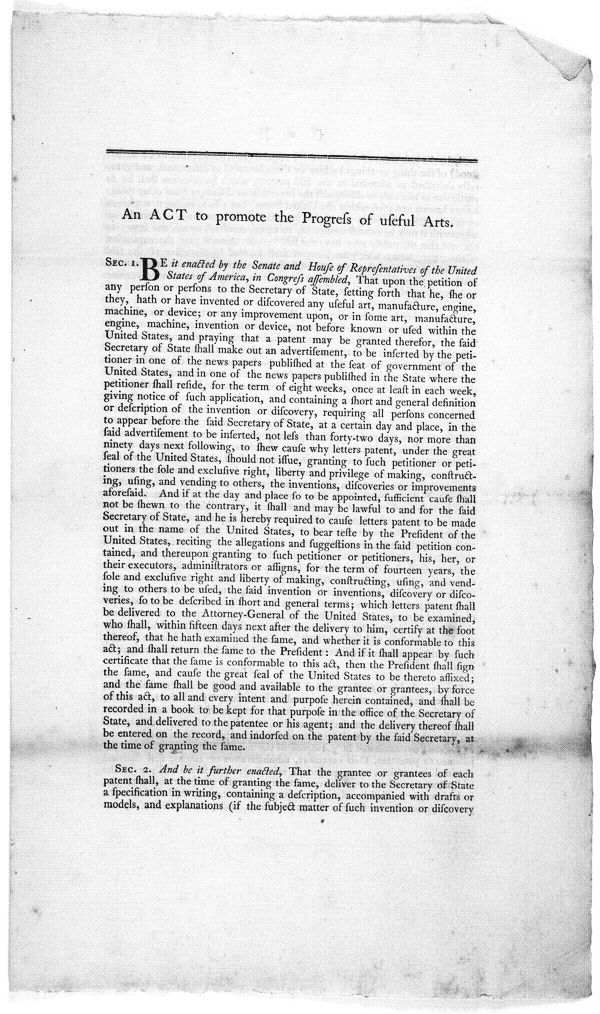
When the United States enacted their first Patent Act in 1790, they made the issuance a matter of the highest importance. There was no patent office. The president himself (George Washington) with assistance of a committee of three (Thomas Jefferson, Henry Knox and the Attorney General Edmund Randolph) met on the last Saturday of every month to review each and every patent application. They established strict rules for obtaining a patent [1].

Although that resulted in too few patents and was soon changed to allow patents without any substantial patent review, this first system of a Patent Review Board consisting of politicians rather than technicians, was never repeated again in any patent system after 1790.

This may soon end. If the European Parliament gets its way, review of patent applications must be a job done under “democratic” supervision. On October 12, the European parliament agreed by a large majority to the European Commission’s plan of going forward with talks on patent reform in Europe, but with a number of amendments to the current plan aimed at ensuring “democratic control” of the process. The vote of the EP was on the Commission’s plan to support the EPLA (see earlier IPEG posts), so the question whether the European Community should “accede to” the European Patent Litigation Agreement (EPLA), which would mean –among other things - the setting up of a European patent court.

Do we want politicians to rule on novelty and inventive step? Hell, no! This very idea signals a worrisome trend in the way politicians look upon intellectual property. Where European innovation falls significantly behind the US and Asia and China surpasses Germany as the 5th world largest supplier of patent applications one would expect European politicians to focus on enhancing innovation rather than beset us with ludicrous ideas about “democratic” review of how patents are being granted by the EPO. European Parliament’s engrossment with so called “undesirable patents” coming out of the EPO (an allegation grossly exaggerated, see memo Severin de Wit to the Dutch Ministry of Economic Affairs of April 15, 2005) prevents a fact-based discussion on how to improve the patent system. It misguidedly focuses on issues that are irrelevant and do not at all help us making the patent system a more effective instrument to further innovation.

The idea of “democratic supervision” is both without merit, incomprehensible and legally nonsensical. Without merit because the question whether a patent has been rightfully granted by the European Patent Office is ultimately for the judiciary to decide, not the lawmakers, nor the executive. Incomprehensible, because there are much more pressing issues to be resolved by European Parliament in making the patent system more apt to the 21st century. Last but not least the whole idea is legally nonsense.

Patents are being granted by the European Patent Office, which is the executive arm of the European Patent Organization, an intergovernmental body set up under the European Patent Convention (“EPC”), whose members are the EPC’s 31 contracting states. Established by the EPC (or “Convention on the Grant of European Patents”), signed in Munich 1973, the EPO is the outcome of the European countries' collective political determination to establish a uniform patent system in Europe. The activities of the EPO are supervised by the Organization’s Administrative Council, composed of delegates from the contracting states. Oversight is being conducted by this Council. Any member of the EU Parliament can lobby its own national members of parliament to take positions and come up with new ideas in the EPO’s Administrative Council.

So what is in the European Parliament members mind when they talk about “democratic” supervision? Do they refer to the concern that EPLA judges would be mostly recruited from the EPO’s Appeal Boards? That is a legitimate concern, but what has that to do with “democratic” review? Or do MEPs mean to say that the current ideas about EPLA and the proposed system of judicial review of EPO patents should not be done by contracting states individually (so by an international agreement between European states), rather than by means of EU legislation like the Community Patent? If that’s the case, again it is a point to make, but what does that have to do with democratizing the grant of patents?

Alternatively, is it that MEPs want to have a say what type of inventions qualify as a “patent” (vide the discussion on software patents)? Lets hope this is not what MEPs really want, because if they do, we better abandon the whole patent system altogether. Why would anyone be attracted by the idea that 732 MEPs vote whether an invention is novel and inventive, so worthy of a European patent?

[1]“Hot Property” by Pat Choate, New York 2005, p.27/28

11 October 2006

AIPPI adopts resolutions on EPLA and other important patent issues

On 11 October 2006, during the 40th World Congress of the International Association for the Protection of Intellectual Property (AIPPI) in Gothenburg, Sweden, 1,500 national representatives of 44 countries voted on a number of resolutions on pressing IP issues.

A Resolution on EPLA (the European Patent Litigation Agreement), was accepted by the AIPPI representatives. It

"urges the member states of the European Patent Organization

a) to adopt EPLA after convocation of a Diplomatic Conference as early as possible.

b) to invite the European Community represented by the European Commission to co-operate in the preparatory work for the conference with the goal it being ensured that the legal rules of EPLA be in conformity with Community law."

Furthermore the AIPPI World Congress accepted a resolution on other important IP issues, among which the harmonization of national laws on assignment and license of IP rights and the treatment of IP licenses in bankruptcy proceedings.

The Resolution “Q190”, adopted and prepared by a Working Group and discussed by representatives of all countries present at the AIPPI World Congress, calls for harmonization of laws regarding the treatment of assignment of IPRs. IPRs can only be successfully treated as collateral if more certainty is given to the assignee of those rights, in many cases banks and other financial institutions. By doing so, the AIPPI working groups, supported by the General Assembly of the AIPPI, expects that the economic importance of IPRs and its use in financial transactions, will be enhanced.

(see column at the right side "IP Docs" for translations of the Resolution Q190 in Spanish, French, and German)

Further comment on CFS Bakel vs. Stork Titan


In patent infringement litigation (and for the infringement of certain other intellectual property rights), typically, a ‘letter before action’ will be sent as a final attempt to reach a settlement before issuing proceedings. In the Netherlands, these warning letters are often sent by means of having a bailiff issue a 'writ of warning'. On 29 September 2006, the Dutch Supreme Court ruled in the case CFS Bakel vs. Stork Titan B.V, after comparing the warning letter regimes in Germany and the United Kingdom, that the patentee who invokes a pre-examined patent (i.e. the Dutch part of a European patent) which is subsequently revoked or nullified acts unlawfully if he knows, or ought to be aware, that there is a serious, not negligible chance that the patent will not be maintained in opposition or revocation proceedings (see: earlier post on this blog http://ipgeek.blogspot.com/). The rights-holder may now need to exercise more caution or risk facing an action for ‘unlawful enforcement’.

Traditionally, the Dutch take a liberal approach regarding patentees (or other right holders, for that matter) for sending a warning letter to the competition (which is considered to be the first step in the enforcement process). In 2001, the Dutch Court of Appeal confirmed the rather strict test for the unlawful issuance of warning letters: the mere fact that a patent was ultimately revoked did not necessarily mean that the enforcement of the patent was unlawful. The patentee would be at risk of a claim that the enforcement was unlawful (only) if it knew or ought reasonably to have known at the time of issuing the threat that its patent was not valid [1].
In the Supreme Court decision in CFS Bakel vs. Stork Titan B.V., the test appears to have been somewhat revised, in that the patentee's assumed knowledge has now shifted from the fact that the patent is invalid to the fact that there is a serious, not negligible chance that the patent will not be maintained in opposition or revocation proceedings.

While one could argue that in any patent case there is a serious, not negligible chance that the patent is invalid, it does not appear at all to have been the aim of the Supreme Court to hold a patentee liable per se for its action for the very reason that the patent is being revoked in the end (with the implication of an inherently serious, not negligible risk that this would happen which the patentee knew or should have known). Contrary to that, in the grounds of its decision, the Supreme Court refers back to its own decision of 1962 [2] in which it was held that to make the act of issuing a writ of warning unlawful it is not sufficient that the pretension embodied in the writ proves incorrect in retrospect (either the asserted patent being (partially) revoked and/or the patent not being infringed); it required that blame for this act can be attributed to the patentee.

Subsequently, the Supreme Court refers to the regimes in Germany and the United Kingdom as regards issuing warning letters, and concludes that in neither of those countries it is accepted that a patent proprietor who has invoked his patent, is liable to compensate the damage suffered by his competitors or others as a result of this act, on the mere ground that the patent is subsequently revoked or annulled; the regime in both countries equally requires that some sort of blame can be attributed to the patentee, according to the Supreme Court. On the basis hereof, the Supreme Court holds that the patentee who invokes a pre-examined patent which is subsequently revoked or nullified acts unlawfully if he knows, or ought to be aware, that there is a serious, not negligible chance that the patent will not be maintained in opposition or revocation proceedings.

In its decision making, the Supreme Court for the larger part has followed the opinion of the Advocate-General Huydecoper. The Advocate-General in his opinion emphasizes that given the fact that the patent survived examination before the European Patent Office – which requires quite considerable efforts from the later patentee, and particularly serves the interests of the competition – 'one can not ask much more' from a patentee to verify that its patent is valid. The Advocate-General makes an exception to the rule, however, in case the later patentee withheld relevant information from the patent office, or acquires new information after grant which sheds a new light on the validity of the patent as granted. Unfortunately, the Supreme Court did not rule on these particular aspects. It therefore remains to be seen whether the Supreme Court decision is to be interpreted in accordance also with this part of the AG's opinion (which would definitively constitute a shift in case law).

Francis van Velsen, Simmons & Simmons (Rotterdam, Netherlands)
[1 Koppert-v-Boekestein, Court of Appeal, 20 September 2001, IER 2001/57
[2] Drefvelin-v-Wientjes, Supreme Court, 6 April 1962, NJ 1965/116

06 October 2006

Is the patentee liable for wrongfully asserting his patent?

Last Friday, September 29, the Supreme Court of The Netherlands (“Hoge Raad”) handed down its decision in CFS Bakel B.V. vs. Stork Titan B.V. (Dutch, English translation here) which considered a patentee's liability for actions taken on the basis of a patent which subsequently turned out to be invalid.
Whilst apparently endorsing the earlier approach as set out in a Supreme Court case dating from 1962 (in the case Drefelin vs. Wientjes, NJ 1965/116), where it was held that a patentee would not be liable in tort unless he acted reprehensibly, the Supreme Court gave a further gloss to the test. It would appear that the standard for tortious liability to arise is now lower than it was previously.
The Supreme Court in CFS Bakel vs. Stork held as follows:
"This means that the patentee who relies on an examined patent which is later revoked or cancelled acts tortiously if he knows, or ought to understand, that there is a serious, non-negligible chance that the patent will not survive opposition or invalidity proceedings. The mere fact that an opposition or invalidity proceedings are pending is therefore insufficient reason for tortious liability to arise."
What the Supreme Court has done is to borrow a test from summary proceedings (where an injunction will be granted unless there is a serious, non-negligible chance that the patent will not survive opposition or invalidity proceedings) and use this as the basis for tortious liability. The test would seem to be more easily satisfied than the earlier test as applied by, for example, the Court of Appeal of The Hague in the case of Koppert vs. Boekestein (IER 2001/57). There, it was held that a patentee would behave reprehensibly if he exerted his patent rights whilst knowing or having a serious reason to suspect that the patent was invalid.
The test was similarly applied recently by the District Court The Hague in the decision of 13 July 2005 in the case of Astée Flowers vs. Danziger 'Dan' Flower Farm (BIE 2006/60), a case concerning plant breeders' rights. Here, the Court held that whether or not liability was made out was likely to depend on whether or not the right was relied upon within or outside the framework of legal proceedings, and whether or not the threat was directed against a primary infringer or against his customers in the marketplace.
The same test was also applied by the District Court The Hague in Wijbenga Machines vs. Eisenkolb (April 19, 2006) and in interim proceedings (by the same court) in Novogen vs. Care for Women (January 11, 2006). There, it was held that the fact that 19 oppositions had been filed at the EPO against the patent was not in itself a reason to find the patentee tortiously liable vis-à-vis the defendant. (The patentee had threatened the defendant's customers with infringement proceedings if they continued to stock the defendant's allegedly infringing product, and had omitted to mention the fact that the oppositions had been filed). The judge did however imply that continuing to threaten the marketplace with the patent after his own finding that the patent stood a good chance of being invalidated would be likely to give rise to tortious liability in the future.
Clearly, there is a difference between a party knowing or having a serious reason to suspect that a patent is invalid on the one hand and the situation where a patentee understands (or ought to understand) that there is a serious, non-negligible chance that the patent will not survive opposition or invalidity proceedings. Estimating the chances of success in a patent action is not an exact science. In cases which end up in Court, there generally will be (at least in the eyes of the alleged infringer) a reasonable chance that the patent will indeed be defeated (or that infringement will not be made out): otherwise the case would presumably settle. How the lower Courts will come to terms with the new gloss remains to be seen.

Simon C. Dack, Barrister De Brauw Blackstone Westbroek The Hague, Netherlands

05 October 2006

EU public consultation on a Future Single Market Policy and SME’s


In an earlier post we referred to the launching by the EU commission of a hearing on a Future Patent Policy. The report of the public hearing as well as a summary of preliminary findings can be found at the EU Internal Market website.

On September 21, the EU Commission published the report of another public consultation, on the Future of a Single Market Policy, launched in April 2006. The results, as far as patents is concerned, aren’t particularly shocking. In the executive summary it refers only once to patents, saying:
“Many argue that improving the intellectual property framework should be treated as a priority, in particular in patents and copyright. Finally, many see the opportunity for fostering innovation through public procurement rules (including for SME’s) and stress the need for increased awareness-raising for public authorities and SME’s, and better implementation and enforcement.”
It strikes us as odd, that the continuous concern expressed for the position of SME’s does not translate into a more active attitude towards patent and innovation issues by those same SME’s and their representatives. Little is known (let alone being supported by research data) how SME’s are affected by the present patent system and in what sense they have are harmed by insufficient enforcement or access to that system. It is striking that it are the SME’s that actually fail to apply for EP patents, some noting the costs of application, but again little material substantiating this claim is being presented. Again and again the position of SME’s are being mentioned as being the main victim of high costs, little access to enforcement and other perceived disadvantages over bigger industry. We have still to see what evidence is being presented to support that. It becomes time to have a more active and conclusive SME organization stopping whining about the patent system, translations and barriers to access, but rather contributing to improvements of the present system, support for a uniform enforcement system like EPLA and present a workable solution for the always present translation issue.

02 October 2006

EPLA, the next big thing, will it fly?


October will be an important month for the EPLA ("European Patent Litigation Agreement”) initiative. However, the initiative threatens to become prey to anti-patent lobbyists (formerly known as anti-software patent lobbyists). They are now taking aim at EPLA. Last week the European Parliament debated the issue with EU commissioner McCreevy, who finally spoke in support of EPLA (see earlier post: “EPLA, The Next Anti-Patent Punchbag”). Several draft regulations have been discussed. On October 12, the European Parliament will vote on motions and draft resolutions debated last week.

The current debate, however, is being distorted by arguments that EPLA is nothing but a “coverted” way to enable the much despised software patents ‘through the back door” (One blog gave a taste of this sort of bully arguments stating “EPLA=software patent”). The loudest antis among the lobbyists do not blench at spreading outright nonsense, wrongly citing industry representatives (GSK, Nokia) to “prove” that multinational patent litigation is rare in Europe and confusing legitimate concerns with opposition (issues about cost, independent and qualified patent judges, location of the court, languages, etc). Opponents, like was the case in the software debate, use manipulative arguments and in some cases plain nonsense to get their message across. A proper and sound discussion is not helped by some opponents’ arguments. What to think of a press release by the Green/EFA group in the European parliament, heading: “EU Commission must not introduce EU patents by the backdoor”. If this is the way in which such formidable legislative work undertaken by EPC countries and IP professionals, is being debated than expect not less than a similar fate for the EPLA as for the CII (the EU Directive on “Computer Implemented Inventions”) which was defeated in European Parliament last year.
Supporters of the EPLA are also to blame. They often speak with double tongue and seem unable to launch a strong unequivocal support for EPLA. The drafters of the EPLA, most notably also the patent practitioners, organized in EPLAW, remain silent if it comes to counter arguments by opponents.

One big difference though. The EU parliament has formally no say about the EPLA, as this is a proposed legislative initiative of the same countries that initiated the coming into existence of the EPC, the European convention that created a European Patent in 1973. It is not the EU Council or EU Commission that propose EPLA, so strictly speaking EPLA is simply not subject to EU Parliament approval. Yet, politically, EPLA will not become reality if the EU Commission (Commissioner McCreevy is forced to withhold his support for the EPLA. The anti software lobby seems to accept no les than that.

The EPLA is, by all means, the “next big thing” since the major legislative task of creating the European Patent Convention of 1973 (“EPC”) . More than 30 years after this successful creation of the grant of a single European patent, Europe has been struggling to find a way to also harmonize the enforcement of patents issued by the European Patent Office. To grant a patent along uniform rules was one thing, to create a system where holders of that right can enforce it all over Europe in a predictable, cost effective and uniform way, is quite another. What seems to be forgotten in the discussions is that strong patents are beneficial to innovative activities. Innovation through protecting inventions is at the heart of post war industry policies in Europe.

Practitioners have, on behalf of their clients, tried various other ways to create a EU wide enforcement system for European patents. The cross border practice, initiated by Netherlands and Germany was recently cut off as a enforcement tool by the ECJ in its GAT vs. LuK and Primus cs vs. Roche decisions. The Community Patent (“ComPat”) although not yet formally dead, is highly unlikely to ever revive, strangled in language and costs issues. ComPat was drafted by Eurocrats, yet killed by politicians, EPLA is drafted by technocrats. Will it also be killed by politicians?

If the supporters do a similar weak job in lobbying for the EPLA at political level as they did with the CII initiative and only ridicule the opponents, without a thorough and constructive debate, EPLA is doomed to fail. The only way to go forward is to have a sound and constructive discussion between those in favor and those opposed. Industry representatives should speak with one tongue, should discuss issues with the EPLA with SME representatives among each other in industry and other lobby organizations like UNICE and similar groups. They should undertake a joint effort to make EPLA even better, not to “double tongue”. Likewise, if the opponents continue to debate the way they have aired their views so far, there will be no progress and this great initiative will not fly. It would be a disaster for Europe’s innovation policy, we will not be able to have a effective answer to growing competition of China, we will be much less effective to challenge the Asian tigers than the Americans do and we will end up in a divided Europe, with patents not being used effectively for what they are created for: foster innovation.

Agreed, the relation between innovation and patents need to be (further) researched and updated. Policymakers need to be provided with academic and independent research into the relation between innovation and patents. In Europe we can learn from the way in which in the US that same debate on quality of patents and innovation is being held.

To be continued.

28 September 2006

CFI: innovation may render pricing rules in parallel trading acceptable


Yesterday, the European Court of First Instance (CFI) delivered its long-awaited judgement in the case GSK vs EU Commission relating to a Spanish parallel import case. GSK’s dual pricing scheme introduced in Spain did not find explicit blessing by the CFI but the European Commission’s decision was quashed in some key respects. The Commission will have to do a better job when re-analysing GSK’s 1998 “General Sales Conditions” introducing one price for drugs resold subject to price controls in Spain and a (higher) price for drugs sold abroad.

The CFI held that there is no presumption that agreements between pharmaceutical companies and wholesalers intending to limit parallel trade have as their object the restriction of competition. The CFI recognises that the market for medicines is not one of free play of supply and demand. Lower prices may not necessarily be passed on to consumers: they may benefit only those “vectors of artificial competition”. The CFI went on to hold after examining the context that parallel trade permits a limited but real reduction in the prices of medicines so that the conditions were anti-competitive in effect. Exemption may be available, however, on the basis that the conditions contributed to innovation, an issue which the Commission had not satisfactorily examined.

The CFI’s ruling can be seen as part of the “new approach” taken by Luxembourg to pharmaceutical cases which the European Commission will have to adopt. Advocate-General Jacobs in his Opinion in Syfait, in part echoing the Court of First Instance in Bayer (Adalat), widened the scope for a differentiated approach to be taken to restrictions on parallel imports in the pharmaceutical industry. Where it can be shown that the endconsumer of medicines is not deprived of concrete benefits of parallel trade in the form of cheaper pharmaceuticals, restrictions on parallel trade may be in line with EC competition law; and arguments for exemption should be examined in detail, and may succeed.

(source: Oliver Heinisch, Tony Woodgate, Rowan Freeland, Simmons & Simmons (London, UK)
Never was the word "innovation" mentioned by the CFI so many times in one decision, 29 times. The CFI specially deals with the relationship between innovation, parallel trade and competition in the pharmaceutical sector (see par. 265-297)

27 September 2006

French Constitutional Council to Rule on London Agreement


France's Constitutional Council is due to rule on the constitutionality of the London Agreement by the end of next week. Ratification by France is the chief remaining obstacle stopping the London Agreement coming into force. The "London Agreement" is about translations of patents in Europe and is drafted as a Protocol on the European Patent Convention. It has been signed by 10 countries to date. To enter into force, at least 8 countries must ratify it including France, Germany and the United Kingdom. The current situation in Europe is that after the grant of a European patent, each country for which protection is sought requires translation of the full text of the patent into its national language.

For an average European patent [1], the patent owner thus pays an estimated € 11, 520 for translations, even though in the majority of cases the translations are never consulted. Under the London Agreement, the states would entirely or partly give up their right to a translation:

· in countries having English, German or French as an official language, no translation is required
· countries where English, German or French is not an official language would only require a translation of the claims in the national language; a translation of the description will only be required if it is not available in an EPO official language prescribed by the country concerned.

· a full translation may be required in case of litigation before the courts.
The savings to patent holders will depend on the number of countries which eventually participate, but it is expected that translation costs can be reduced by 50% if 12 countries join. The London Agreement would make therefore patent protection in Europe much cheaper. Seventy-six French parliamentarians voted to ask the Council to rule on the Agreement on September 2. The Council consists of nine appointed members and Valéry Giscard d'Estaing, who, as a former president, is entitled to sit on the constitutional body. Its job is to decide whether new legislation complies with the country's 1958 Constitution. The Council can only rule if an application is referred to it before a new law is signed by the president. Such applications are normally filed by the parliamentary opposition where it believes that civil rights are at risk.

If implemented, the London Agreement would reduce translation requirements for European patents by allowing member states to opt-out of requiring a translation into their national language.

If the Council rules that the Agreement complies with the Constitution, the country's parliament and President Chirac will be able to proceed with the ratification process. However it is doubtful whether there will be ratification ahead of the presidential election in 2007.

[1] "Average European patent" means a patent covering 8 countries for 10 years, other costs include procedural fees to be paid to the European Patent Office (Euro 4300), patent attorneys fees (Euro 5500) and national maintenance fees (Euro 8900).

26 September 2006

Dutch Proposal for Favorable Patent Tax Treatment


Today, the Netherlands Parliament discusses a proposal of May 2006 for a new Tax Law, amending the Dutch 1969 Corporation Tax Act to introduce a so called “Patent Box”. The facility enables companies and organisations which have filed and obtained patents as a result of their R&D output in The Netherlands. With a view to encourage investments in research and development, the law proposes that costs of producing self-developed intangible assets (invention disclosures from R&D leading to a patent) do not have to be capitalised but can be immediately charged to the taxable result.

Furthermore, upon request to apply the ‘patent box’, the ‘net earnings’ derived from self-developed intangible assets may be taxed against a decreased rate of 10%. If the tax payer elects to apply the ‘patent box’, it will have to reverse the deduction of R&D expenses taken into account in previous years (taxable against the main tax rates); the capitalised R&D expenses may subsequently be amortised over the economic lifetime of the patent. While the term ‘earnings’ is not limited to formal royalty income, earnings in respect of trademarks and logos are not eligible for the patent box. The patent box can be applied to intra-group royalty income as well as third party royalty income. The amount of net earnings in which respect the patent box may be applied is capped at four times the total amount of the capitalised R&D cost. The patent box is still being further discussed with the European Commission.
Peter Flipsen , tax partner at Simmons & Simmons, published his critical views on these “Patent Box” proposals in the August issue of the Dutch tax monthly, "Maandblad Belasting Beschouwingen” (MBB). In his view the proposal contains to many restrictions (the most of which is the limitation of the 10% rate to maximum 4 times the research and development costs of patents included in the box) to make it attractive for companies to establish their R&D activities in the Netherlands or to have R&D activities performed for the benefit of Dutch entities.
(source: Loyens Loeff, “flash” publications, May 26, 2006).

21 September 2006

German Highest Court Rules on Employee Invention


The German Federal Supreme Court (Bundesgerichtshof, or “BGH”) ruled on a complex issue: employee’s inventions (German Employees’ Invention Act) in what is now known as the “Haftetikett”-decision. The BGH held that an employer can be liable for damages if an employee cannot register his invention as a patent or utility model in a country because the employer has used (but not registered) the invention there. A former employee of a manufacturer of adhesive labels had, during his employment, invented an adhesive made of natural rubber. The employer registered patents for the invention in Germany and a number of other countries, and subsequently started using the invention to make labels in some of those countries, and also in Australia but without registering a patent there. The employer later stopped production. The inventor was unable to register a patent in Australia, as his former employer had used the invention there. He successfully claimed compensation for the loss of this right. The court said that an employer was not obliged to register a patent or utility model for an employee’s invention that it had claimed (under employment law). However, it must inform the employee that it was not applying to register and in which countries. This obligation is based on an employer’s general duty to act in the interest of its employees, including former employees.

In essence, the BGH confirmed the ruling of the Düsseldorf Regional and Düsseldorf Appeal court that the 4-month deadline during which an employer has to claim ownership vis-à-vis its employee with regard to any invention - is a conclusive deadline and, more important, that such 4-month deadline does not only start running with a notification by the employee but also if the employer has sufficient knowledge about the potential invention.

The BGH ruled that this normally is the case if the employer files for a patent. This means that in practice the 4-month deadline starts running at the date the patent application was filed. If the 4-month deadline expires and the employer has not claimed ownership, ownership rests with the employee. This conclusion is quite in contrast with the practice of the arbitration chamber who has competence on disputes relating to the calculation of the compensation. The arbitration chamber took the view that the 4-month deadline cannot start as long as the employee has not properly notified the invention to the employer with the detailed description. The practice could work with the arbitration chamber's rulings as employees quite often did not properly notify their invention so that the deadline did not start. This practice now has to change with the ruling of the Federal Supreme Court as the 4-month deadline regularly at the latest starts with the patent application.

The consequences for the practice in Germany are significant:

** Patent attorneys operating in Germany have to inform their clients about the beginning of the 4-month deadline (some may have advised according to the practice of the arbitration chamber).

** Companies operating in Germany, in particular mid-sized companies, have to take the obligations under the German Employees' Invention Act more seriously as they may risk losing ownership of inventions made by their employees.

** Companies have to adopt and implement internal rules and systems in order to comply with the German Employees' Invention Act.

** For a transitory period it may be an attractive defense strategy for a (potential) patent infringer to approach current or former employees who have been co-inventors in order to obtain ownership to this invention from them by direct transfer.
Peter Meyer, Simmons & Simmons, Düsseldorf

19 September 2006

Ranbaxy loses patent challenge against Pfizer's Lipitor drug in Netherlands


The District Court in The Hague, Netherlands ruled on September 13 mainly in favor of Warner Lambert (Pfizer) in two judgments against Ranbaxy, one decision related to EP patent 0 247 633 and the other decision on EP patent 0 409 281. The judgements are part of an ongoing patent litigation between Warner-Lambert (Pfizer) and Ranbaxy, an India based drugs manufacturer.

Center stage of this litigation is the highly successful cholesterol-lowering drug Lipitor, consisting of “atorvastatin”, an enantiomeric substance, containing a dihydroxyheptanoic acid chain, suitable to inhibition of cholesterol synthesis in the human body. The District Court The Hague held Warner-Lambert's European Patent 0 247 633 in the Netherlands to be valid. Warner-Lambert's European Patent 0 409 281 — covering the calcium salt of atorvastatin which had been challenged by Ranbaxy — was held to be invalid in the Netherlands.

Pfizer has applied for a number of patents related to the inhibition of cholesterol synthesis, two of which are being dealt with in these two court decisions. The first patent, EP 0 247 633 was granted on 30 January 1991, upon an application as filed on 29 May 1987, with a priority claim as of 30 May 1986. The '633 patent expires in 2007. The second patent, EP 0 409 281 was granted in 2001, upon an application as filed in 1990, with a priority claim of 21 July 1989. The '281 patent expires in July 2010. Pfizer applied for Supplementary Protection Certificates ("SPCs") in (most of) the designated states in Europe on the basis of the '633 patent for Lipitor. In The Netherlands, Pfizer obtained an SPC expiring November 5, 2011.

Ranbaxy argued that Pfizer’s SPCs are invalid as they are based on the ‘633 patent which patent – according to Ranbaxy - does not cover atorvastatin. Ranbaxy’s basic position is that atorvastatin is an enantiomeric substance, and that the scope of the '633 patent is limited to racemates only. Ranbaxy defended that support of their view could be found in the patent file history of Pfizer's, e.g. correspondence by Pfizer’s patent attorney with the Danish Patent Office in the Danish application for the national counterpart of the '633 patent. Ranbaxy further supported this claim by pointing to Pfizer's own statements in the prosecution stage of the '281 patent. In the '281 prosecution, the '633 patent was considered to be the closest prior art.
Ranbaxy and Pfizer are involved in disputes related to the (counter parts of the) '633 patent and the '281 patent on a world-wide basis. Actions are pending in the United States, Australia, the United Kingdom, and The Netherlands, as well as in other countries. Ranbaxy has been quite successful in revocation of the (counter parts of the) '281 patent. In view of the '633 patent as the closest prior art, the '281 patent has been nullified for lack of inventive step in multiple jurisdictions. However, Ranbaxy until now appears to be less successful in the nullification of the '633 patent and/or the corresponding SPC, which is Ranbaxy's primary interest in order to be able to likewise market an atorvastatin product like Pfizer's Lipitor.

In several jurisdictions, Pfizer's confirmation of Ranbaxy's view with respect to the scope of the '633 patent has been excluded as evidence. In these proceedings, the scope of protection of the '633 patent has been assessed from the point of view of the skilled person only, while any and all representations limiting the objective scope as made by the patentee have been disregarded. For instance in the UK, Pumfrey J was very explicit clear in his judgment of 12 October 2005 regarding the scope of protection of the '633 patent, by ruling:

“At the outset of the trial, I ruled that Ranbaxy could not rely upon certain documents, largely representations made to certain patent offices, in which persons acting for Warner-Lambert had made representations about the disclosure of '633 much the same as that for which Ranbaxy now contend.

I excluded the documents because I considered that they were not admissible on the question of construction”.


Similarly, in the Dutch proceedings, the Dutch Patent Office ("Octrooicentrum Nederland") was asked to provide its expert opinion on inter alia the question whether the skilled person would understand the '633 patent to exclusively cover racemates (and therefore not enantiomers). Octrooicentrum Nederland confirmed in its expert report of 28 March 2006 that it did not consider the file history of the '633 patent, let alone the '281 patent, - and therefore would consider the "objective scope" only - reasoning:
"Octrooicentrum Nederland in the first place stresses that the question,
which must be answered in this expert report, is how the skilled person will
understand patent EP '633 and not what Warner has stated in that respect in any
proceedings."

The District Court The Hague followed this reasoning of the Dutch Patent Office . The result is that the '633 patent is being considered as the true “basic” patent (within the meaning of Article 3 sub a of Regulation 1768/92/EEC) covering the Lipitor product. The Court disregarded evidence filed by Ranbaxy – all based on prosecution file history of the'633 Danish counter part and the '281 patent - in assessing the scope of protection of the '633 patent.

In most other European countries, like the UK, France and Germany, consultation of the prosecution file history is excluded as evidence, mainly from the point of view that it cannot contribute to the assessment by the skilled person of the scope of protection. In The Netherlands (like in some other smaller jurisdictions), quite a liberal attitude has been adopted in the past vis-à-vis consultation of the prosecution file history in assessing the scope of protection of a patent (often compared to the US “file history estoppel”).

The ruling means that Ranbaxy is prevented from launching its drug before Lipitor's basic patent EP ‘633), which expires in November 2011.
See also "Lipitor battle in the Netherlands—District Court invalidates Warner-Lambert’s EP ’281 and holds EP ’633 infringed", Klaas Bisschop, Ruud van der Velden, Journal of Intellectual Property Law & Practice, 2006, Vol. 1, No. 13 (December 2006)

Google ordered to remove news from French & German speaking newspapers


News on the European copyright front. On September 5, a Belgian court ordered Google to remove all articles, photographs and graphics from French and German speaking newspapers. Copiepresse issued the complaint in summary proceedings and won the court ruling. Not only does this require Google to remove content from Google News, the court order requires removing the content from the Google cache as well and to publish the full text of the judgement on its websites. I like a comment I found on one of the blogs reporting the story:

"What’s next, when you get a parking fine having to drive around for a week with
text on your car saying that you parked at the wrong place."

17 September 2006

Who is going to Stop Europe’s Patent Troll?

How Sisvel can get away with cowboy type legal actions as the one they now provoked in Germany (see previous post) is puzzling. Sisvel did it in Italy with Motorola (who had to give up and take a license), they now repeat it in Germany, trying to force SanDisk into taking a license. SanDisk, however, is of the opinion that the underlying three patents are invalid and not infringed upon. SanDisk is involved in civil patent litigations in Germany, The Netherlands and the UK. The outcome of these cases is not expected any time soon, at least not before Spring 2007 (if Sisvel will not find other cowboy methods to force SanDisk into taking a license).

The mp3 cases Sisvel is pursuing are not about counterfeits, they are about legitimately manufactured mp3 enabled consumer devices made by such giants as Apple, Motorola, Samsung, LG, Matsushita, Sony Ericsson, Creative, etc. Since when does a patent license issue (so a dispute about money, royalties, or license fees) ends up in a criminal court? It is because Sisvel’s arguments in a civil (patent) court don’t do the job. Which job? Extracting license fees for three patents that are invalid, not infringed upon and will not stand the ultimate test by any civil (patent) court. However the strategy is to fight any “infringer” (read: legitimate manufacturer of mp3 enabled consumer devices) by seizing goods at Customs (using the EU Border Regulation in a TRIPS incompliant way), use the criminal system in Italy and Germany to your advantage by misleading the public prosecutor (and the court for that matter) pretending you are chasing “counterfeits”? Sisvel’s managing director Dini gave an interview (in mp3 file) recently, pretending what Sisvel is doing is the right thing: "over 600 licensees have been entered into, so what’s wrong with Sisvel’s methods? They just do their job, right?" one would say.

Wrong. There is a clear and present danger that patent strategies of Europe’s biggest Patent Troll will stifle innovation, keep competitors off the EU market illegitimately, extract licenses out of good businesses for an invention that was someone else’s (if at all an invention) and hence invoking -what I believe to be - invalid patents, thus misusing patent law, as is witnessed by:

1. use of invalid patents (not "novel" invention, Chambers, a BBC researcher, sugegsted exactly what has been described in the patented, years before the patent claimed it as their “invention”)
2. misleading Customs by letting them issue Border Detention Orders against (mostly) without proof of infringement, which is a must under the TRIPS Convention

3. charging license fees that are ludicrously high and certainly not “RAND” (“Reasonable And Non-Discriminatory”), as obliged under standard setting rules

4. misleading public prosecutors in Italy and Germany by making them believe all mp3 players they are chasing are made by “counterfeiters”, not telling what the real market situation is

5. pretending mp3 patents under their management are “real break through inventions” and deserve public recognition and licensee fees that amount to over 500 million euros

6. pretending that Sisvel does not need to show infringement by each and every player they seize, erroneously arguing that they need not do so as the mp3 patents under management are “essential patents” under ISO/IEC Standard 11172-3.

7. breaching EU law by entering a clause in license agreements that forbid licensee in Europe to challenge the validity of the patent (contrary to clear antitrust regulations of the EU) where the TTBE is not applicable taken Sisvel 100% market share (by their own admission, as all mp3 players are covered by "essential patents" that "Sisvel owns"

see also: Impact, "Sisvel v SanDisk - as clear as mud - The more you look into the Sisvel v SanDisk bun fight, the less clear it all becomes!" (Impact is a "blog about intellectual property and IT law from a UK perspective")

Can a Different Judge overrule a Colleague in the Same Court?


Yes. Actually that’s possible, at least in Germany, correction, at least in Berlin, oops, at least in the “Tiergarten” Municipal Court in Berlin. A tiergarten (“zoo”) it is. We earlier wrote about Sisvel’s attempts to bring Patent Wild West practices into the German Courts. It gets funnier. What happened after Judge Ziegler of the Berlin “Tiergarten” Court declared the action of the Public Prosecutor in the SanDisk seizure case (IFA, Berlin) “illegal”? The day Judge Ziegler was absent from the court, the Public Prosecutor – unhappy about him losing his case - filed a new application for stopping the release of the SanDisk mp3 players, before another judge at the same court, Judge Buckow and got what he wanted. He argued before the new judge that the goods need to be examined before a further decision can be taken. He succeeded in convincing the second Judge - without informing SanDisk lawyers (and I am sure without informing Judge Ziegler either) that the goods should be kept until they have been examined before a decision about a seizure shall be made. Be aware: this was not an appeal court but the same Municipal court, just a different judge. Click here for the second judgement.

The request (as well as the second one, surely initiated by Sisvel who must have convinced the Public Prosecutor that patent law was a whole lot more fun than criminal law) makes a mockery of law and more resembles a Bunko game than a legitimate legal process. How can a one and the same court rule the opposite way on the same set of facts within two days? And since when does Sisvel need “to examine” where in civil court they consistently take the position that they do not need to examine mp3 players (from whoever) as all mp3 players on the EU market need to use an industry standard and the patent happen to be “essential patents” under that same standard, so everyone must use the patents by the mere fact that they are labeled “mp3”?

We have sufficient belief in the German legal system that someone will stand up and stop this nonsensical use of the criminal system for patent troll’s purposes.

15 September 2006

The Lawyer European Legal Forum, Berlin


On September 28 and 29 the English publishing house "The Lawyer" organises the "European Legal Forum", intended for in-house counsel of European companies. Key note speaker is Eberhard Uhlmann, Secretary General and General Counsel of the European Investment Bank. He will touch upon the success and challenges in funding a productive and competitive Europe and examining how far we need to travel to reach the goals set out in Lisbon to make Europe the economic powerhouse of the world.

On Friday, speakers will deal with the increasing importance of management of IPRs for corporations, and the general counsel’s role in this including “realtime” studies, from which general counsel could learn to deal with IPR cases in an efficient way with in-house patent counsel. Detailing the ongoing management of intellectual property rights in European companies, touching on patent disputes, brand protection, managing IP in new technology and insight into how companies successfully benchmark their IP operations.

Speakers are Beate Lalk-Menzel, Senior Counsel DaimlerChrysler AG, Mats Parup, Head of Corporate Intellectual Property Novartis AG (Switzerland) and Severin de Wit, attorney at Simmons & Simmons Netherlands. For the program click here.

EPO's revocation of coffee pod patent revisited

Simmons & Simmons led the way in securing a victory for Kraft Foods on 30 August against Sara Lee vs. Douwe Egberts at the European Patent Office ("EPO") in Munich, see my earlier post "Sara Lee’s Patent for Coffee Pads Revoked by EPO". Kraft's in-house team was also assisted by Andrew Waugh QC and Dr Peter Klusmann of Hoffmann Eitle.

After a five year battle, the Technical Board of Appeal of the European Patent Office held that Sara Lee's European Patent EP904717 (for an assembly of a container and coffee pod for use in a coffee machine) was invalid and, accordingly, the patent was revoked. Click here for the Minutes of the EPO Appeal Board Meeting (the full text of the decision will only be available later)

The decision ended Sara Lee's attempt to claim exclusionary rights to coffee pod sales utilised in the Senseo coffee pod machine (by Philips) across Europe. Sara Lee's aim was to ensure that consumers only used its Senseo coffee pods, or pods licensed by Sara Lee. Initially Sara Lee sought to enforce its patent against a number of smaller coffee pod manufacturers and retailers in the Netherlands, Belgium and Germany, whose pods (similar to tea bags, but filled with coffee) were suitable for the Senseo machine. A number of smaller companies lodged post-grant opposition proceedings at the EPO and were soon joined by Kraft Foods, the world's second largest branded food & beverage company which is known for its Jacobs, Carte Noire, Kenco and Maxwell House coffee brands in Europe who had been selling coffee pods long before the Sara Lee's patent had been granted.

Opposition proceedings enable a successful party to dismiss a European patent centrally in all the countries for which the patent hasbeen granted (in this case 19 countries across Europe).

Instructing Jeremy Morton and Marc Döring of Simmons & Simmons' London Intellectual Property Group to advise on strategy and represent them at the EPO, Kraft also commenced declaratory proceedings against Sara Lee in the Paris District Court. In response, Sara Lee aggressively pursued infringement proceedings against Kraft in Germany.

The EPO Appeal Board decided to revoke the patent after a thorough review of the arguments presented by both parties. It was a great success both to Kraft and to many other coffee pod producers and retailers, many of whom had already been forced to take licences from Sara Lee under the patent to continue trading. One of Kraft's guiding principles of was "play to win".

Gerd Pleuths, SVP & Deputy General Counsel of Kraft Foods commented:

"Kraft is extremely satisfied with the decision, particularly since we will now
be able to continue selling our coffee pods without any restrictions. Kraft has
been selling its pods for more than 20 years, far longer than Sara Lee. The favourable decision is the result of the very successful cooperation
between our in-house lawyers and our outside counsels at various firms.
However, Simmons & Simmons' Marc Döring played a key role in coordinating all
our efforts which ultimately resulted in this important success."

11 September 2006

EPLA: The Next Anti-Patent Punchbag


Not bothered by an actual knowledge about what EPLA is about and more concerned about his future as an anti software patent crusader now the EU Directive is off the table, he now takes aim against the patent system as such. Florian Mueller, in his blog No Lobbyists As Such, with a Bushonian subtitle "The War over Software Patents in the European Union", does not shy back from uttering the following canard:

"In his speech, he said the European Patent Litigation Agreement (EPLA) “is a goal worth pursuing” and that he wanted to involve the EU in the EPLA negotiations “and bring them to finality”. He falsely claims that the EPLA would “offer valuable cost savings”: even Nokia and pharmaceutical giant GlaxoSmithKline have already pointed out that the opposite would be the case.

His claim that the EPLA is compatible with the idea of an EU-wide Community patent is also a misrepresentation. The EPLA is only about strengthening the European Patent Office (EPO)."

Mueller is referring to EU Commissioner McCreevy's speech last week where he seemed to be more positive and supportive of EPLA than ever before. That, obviously is bad news for those that now use the EPLA as the new punchbag against the patent system as such.

The EPLA is not about "strengthening the EPO". The EPLA is a draft for a European Patent Litigation Agreement (EPLA) with the intention on establishing a European patent litigation system. It is a proposed patent law agreement aimed at creating an "optional protocol to the European Patent Convention (EPC) which would commit its signatory states to an integrated judicial system, including uniform rules of procedure and a common appeal court".

It is a sensible, well thought, enforcement system of patents that have been granted by EPO. It is a proposal for an agreement between member states of the EU Turkey and Switzerland and some member states to the European Patent Organization to establish a Diplomatic Conference, leading to a Treaty whereby the current proposals of a Working Party would be implemented.

In 1973, when the European Patent Convention was establihed, leading to the EPO and an uniform granting of patents, the patent community failed to agree on an enforcement in national courts, of that same European patent. Creating a European patent is one thing, enforcing it throughout Europe at reasonable cost, predictable and protective of interest of patent holders and their opponents, is nothing but a sure way to innovation. And long overdue.

09 September 2006

Voice your Ideas about Issued Patents


Two Americans (Peter Johnson and Kevin Hermansen in Salt Lake City, Utah) recently started WikiPatents, to provide - what they call - "public patent clarity for the world". It fits in a growing trend to publicly voice and comment on the "quality" of the patents, issued by the USPTO (and EPO for that matter, although the new WikiPatent only relates to US patents issued). Could be a good idea for EPO as well, so as to assist the examiner in finding prior art, to be more critical of what is being issued and to hear what the "street" is thinking about their work.

08 September 2006

EU Commissioner McCreevy on EPLA

Charlie McCreevy, Commissioner for Internal Market and Services, gave a speech today on the future of IPR in Europe - updating in particular his plans for patents in Europe. No formal proposals were made, other than a commitment to produce a Communication before the end of the year. However, there was some more positive mood music for the EPLA.

The speech was held at an IPR Conference which was part of an informal ECOFIN Council meeting, organised by the Finnish EU Presidency.

In Brief
Commissioner McCreevy believes that the time is right to make a serious attempt to improve the IPR system in Europe. He welcomed the fact that the Finnish Presidency has singled out innovation as the key factor for Europe's future and said that a good IPR environment is, in turn, a key factor for innovation.

He praised the success of the community trade mark and, more recently, the community design, but contrasted this with the "far from satisfactory" situation regarding patents. "How can you on the one hand say we want the European economy to be the most competitive in the world when on the other hand we have a patent system that is outdated and expensive to enforce? "
McCreevy proposes a two pronged approach: advancing the Community Patent and, in parallel, involving the Community in the EPLA negotiations to bring them to finality. "The Community Patent and the EPLA are not mutually exclusive initiatives. They are both aiming for the same goal: a better, cheaper, more reliable patent system."

Community Patent
McCreevy effectively confirmed that the 2003 Common Political Approach on the Community Patent is now dead. However, he proposed no concrete alternatives other than saying that he wants to be imaginative and to "move this debate along", working with the Finnish Presidency, the upcoming German Presidency and the European Parliament. It seems, therefore, that the Commission is unwilling to give up on the Community Patent even though, without a radical breakthrough, it is unlikely to provide the short (or medium) term solution demanded by industry.

The EPLA
The mood music for this sounds more positive. Commissioner McCreevy recognised that the EPLA offers a unified jurisdiction for European patents and would offer valuable cost savings and increased certainty in regard to patent application. He considered that the EPLA needs Community involvement but that with an active, constructive approach by the Commission, there could be a momentum to achieve a successful outcome.

The comment that "in terms of the jurisdictional arrangements the challenges are similar for both of them" could be taken as lending support to the view held by some that if agreement can be reached on the EPLA, its structure may in turn be "adopted" by the Community Patent if agreement can be reached on that in the future.

Enforcement Directive
Commissioner McCreevy concluded with a stong plea for the implementation of the enforcement directive, which has been patchy so far.

Peter Hill, Simmons & Simmons, London

07 September 2006

Sisvel brings Patent Wild West into Germany


Sisvel, Europe's most notorious patent troll, is known for its unscrupulous way of using (many feel: misusing) the criminal system in Italy, where they convinced Italian public prosecutors - not particularly known for their penchant for patent law - to use the criminal system in an unprecedented way, to enforce its patents it licensed from Philips c.s. against alleged infringers.

The practice has driven many companies in (involuntary) license deals by making their lives miserable and forcing business people to take licenses rather than fighting the patents in court. Big names like Apple, Motorola, Creative, Sony Ericsson, Samsung have given up challenging the Philips mp3 patents, administered by Sisvel, due to Border Detention orders - disrupting distribution channels - and the use by Sisvel of criminal proceedings and other enforcement tricks against those companies.

Now Sisvel has been able to bring the Patent Wild West into Germany.

On September 7, a judge at the Berlin court ruled in favor of SanDisk, arguing that the use by German public prosecutor's office of a criminal "search" and order to seize SanDisk's new Sansa mp3 players at the IFA consumer electronics exhibition in Berlin, was illegal. Today, the public prosecutor not only filed an appeal, he also managed to get another judge (so not an appeal judge) in the same court to overrule his colleagues decision to have the release of the seized SanDisk mp3 players suspended. This application by the public prosecutor was filed at the municipal court in Berlin, which has to decide about these applications to "stay" the release of the seized goods before the matter is forwarded to appeal court. It is said that the public prosecutor decision to appeal the Berlin Court decision and to apply for interim measures was based on directions of the head of his unit. Normally an appeal by the public prosecutor does not postpone the effect of the Berlin Court's order. To circumvent this he applied for an interim decision which would have that very effect.

This highly unusual action by a public prosecutor, usually engaged in fighting crimes, cannot but mean that he is "(mis)guided" by Sisvel, as there is no sensible explanation for seeking interim relief after the trade fair has ended, other than that he is being pressed by Sisvel to do this. Sisvel exports its Wild West enforcement charade it was able to uphold in Italy against honest businesses in Germany.

It is a shame public prosecutor's office let itself be used by Sisvel in this patent wrangle, where it basically is a patent fight that needs to be fought (and actually is fought) in civil courts. SanDisk will, no doubt, seek civil and criminal law suits against both Sisvel and the prosecutor, based on tort, antitrust violation and unfair competition. Whilst not all may be succesfull, one cannot underestimate the "1000 needles" effect which would transform SanDisk from prey to hunter.

For all information on Sisvel proceedings and current legal status of licensing issues, contact Severin de Wit at severin.dewit@ipeg.com